Periodic systems III. Equation of state
An alternative to geometry optimization for periodic systems is to fit energy versus cell volume to an equation of state (EOS). The fit yields the equilibrium volume , the equilibrium lattice energy , and the bulk modulus .
Birch–Murnaghan equation of state
One standard form is the Birch–Murnaghan EOS, written as
Here is the stiffness at equilibrium, and is not redundant with it. The bulk modulus itself changes as the crystal is compressed, and (dimensionless, around 4 for many solids) is the fit parameter that captures that stiffening away from equilibrium.
Calculations scan of diamond’s experimental cell volume in steps of , with the GTH-cc-pVDZ basis, GTH-HF-rev pseudopotential, and RSDF. The fits at each mesh size are summarized below.
| (Å) | (ha) | (GPa) | |
|---|---|---|---|
| 3.923 | −10.307 | 556.383 | |
| 3.607 | −10.958 | 689.53 | |
| 3.573 | −11.022 | 687.106 | |
| 3.568 | −11.029 | 678.893 | |
| 3.567 | −11.028 | 676.799 | |
| 3.567 | −11.027 | 675.894 | |
| 3.567 | −11.026 | 674.652 |
Fitted EOS with HF energies.
| (Å) | (ha) | (GPa) | |
|---|---|---|---|
| 4.004 | −10.499 | 438.281 | |
| 3.625 | −11.193 | 590.371 | |
| 3.582 | −11.277 | 591.995 | |
| 3.575 | −11.292 | 579.976 | |
| 3.573 | −11.295 | 578.070 | |
| 3.572 | −11.296 | 576.769 | |
| 3.572 | −11.297 | 574.986 |
Fitted EOS with MP2 energies.
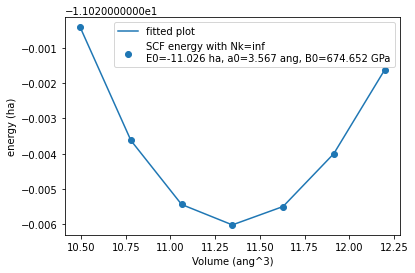
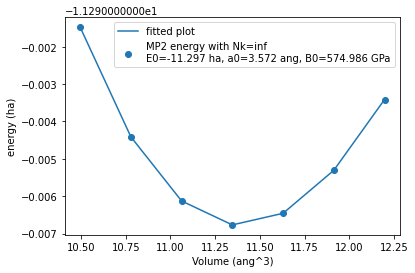
For both HF and MP2, and converge sharply after and stabilize at the second decimal after , showing that the k-mesh is not the most important error source relative to experiment.
The basis set, and the quality of the HF reference
We now compare against a larger basis, GTH-cc-pVQZ, at a mesh.
| (Å) | (ha) | (GPa) | |
|---|---|---|---|
| HF | 3.557 | −11.036 | 490.7 |
| MP2 | 3.555 | −11.374 | 453.0 |
Neither nor from the small basis agrees well with these, and the error is large. Curiously, the small-basis MP2 is closest to the reference at the smallest mesh, which smells like cancellation between the calculation’s errors and the fit’s. MP2 in the small basis is also seemingly less accurate than HF for , despite being the higher-level method. MP2 inherits the HF orbitals, and a poor HF reference thus gets amplified rather than corrected, the same pattern I saw in my undergraduate benchmark, where systems that HF fails tend to suffer poor MP2 results too.
Readjusting the MP2 correlation energy onto the larger-basis HF numbers shows this directly.
| (Å) | (ha) | (GPa) | |
|---|---|---|---|
| MP2 @ QZ-HF | 3.564 | −11.303 | 393.591 |
With the better HF reference, moves toward experiment and toward the large-basis value. The from this mixed treatment overshoots downward, consistent with combining a QZ-quality HF curvature with a DZ-quality correlation correction. The two basis errors no longer cancel the way they do in a consistent small-basis fit. Either way, the quality of the HF reference matters as much as the correlation treatment on top of it.